
Quick Answer
Your home's cleaning routine can be one factor worth considering when your pet becomes exposed to cleaning products. Cats may lick their paws after walking across a freshly cleaned floor, and they may groom themselves after coming into contact with cleaning residues. The risk depends on the product's formulation, concentration, amount of exposure and how it is used. This does not mean every cleaning product is harmful, but understanding how your pet may come into contact with it can help you reduce unnecessary exposure.
Could Something in Your Home Be Affecting Your Pet?
You think carefully about what your pet eats, the treats you give them and the products you use for their grooming. But how often do you think about what your pet comes into contact with around the home every day?
Your cat walks, rests and plays on household floors, then often licks its paws or grooms itself soon after. That means anything left on the floor can end up in its mouth without you noticing.. These everyday habits mean that what comes into contact with their paws and fur can eventually come into contact with them again.
For a pet owner, that raises a simple but important question: could something in your everyday home environment be affecting your pet without you realising it?
The answer is yes. Certain household cleaning products can cause problems for pets but the risk depends on the product and the exposure.
A pet may come into contact with cleaning products by walking across a wet surface, licking its feet afterwards, grooming exposed fur or accidentally coming into contact with a concentrated product. A study published in the Veterinary Clinics of North America: Small Animal Practice suggests that cleaning products contain chemical compounds that may harm pets under certain conditions. The level of risk depends on factors such as the product's formulation, concentration, amount of exposure and how it is used.
This does not mean that every cleaning product is harmful or that normal household cleaning puts pets at risk. It means that understanding how exposure happens can help pet owners make more informed choices and reduce unnecessary contact.

How Can Cleaning Products Reach Your Pet?
Your pet does not have to swallow a cleaning product directly for exposure to happen. Everyday behaviours such as walking, licking and grooming can create different routes of contact.
Walking Across a Wet Floor
When a pet walks across a freshly cleaned floor, the floor cleaner liquid can come into contact with its feet. The ASPCA recommends keeping pets away from freshly cleaned areas until surfaces have dried. It also notes that pets walking through wet cleaning solutions may experience minor skin irritation or stomach upset if they later ingest some of the solution.
Licking Their Paws
Cats often lick their paws as part of normal grooming. If a cleaning solution is still present on the floor or feet, this can create a route for accidental ingestion.
Grooming After Exposure
Cats are particularly thorough groomers. If a substance gets onto their feet or fur, they may ingest small amounts while grooming themselves. This is another reason to allow cleaned surfaces to dry before pets return.
Accidental Contact With Concentrated Products
Exposure to a wet floor is different from exposure to concentrated cleaning products. Spills, open containers or cleaning buckets can result in a much higher level of contact and should always be kept away from pets.
Fumes and Strong Fragrances
Some cleaning products can release fumes or fragrances during use. Research published in the International Journal of Hygiene and Environmental Health has also linked exposure to certain cleaning product emissions with respiratory effects in animals. In Qatar, where air conditioning is often used for long periods and windows may remain closed, keeping the area well ventilated while cleaning can be especially important.
A Few Simple Precautions

What Should You Look For in a Floor Cleaner?
Once you understand how your pet may come into contact with cleaning products, the next question is naturally what you choose to use on the floor they walk, rest and play on every day.
A good floor cleaner is not only about how quickly it removes dirt or how strong it smells. The formulation matters too. Look at the product's ingredients, recommended dilution or dosage, compatible surfaces, and usage instructions. If you have pets, also check the label for any relevant safety precautions and keep pets away from the area while the cleaning solution is wet.
For pet owners, a plant-based formulation with ingredients derived in part from plant sources can be an option for everyday floor cleaning. Its cleaning system includes plant-derived surfactants, enzymes, and probiotics, formulated to help remove everyday dirt and residue. As with any floor cleaner, follow the recommended dilution and usage instructions and keep pets away from the floor while the solution is wet.
Is a plant-based floor cleaner safe for pets?
A well-formulated plant-based floor cleaner can be a suitable choice for homes with pets. But “plant-based” on its own does not guarantee that a product is safe or suitable. What matters is what the product is made with, how it is formulated and how it is meant to be used. So, rather than choosing a product simply because it says plant-based, pet owners should still check the ingredients and follow the product instructions.
Where Does Environ Fit Into That Choice?
For pet owners, choosing a floor cleaner is also about being mindful of the formulation used on the surfaces their pets walk, rest and play on every day.
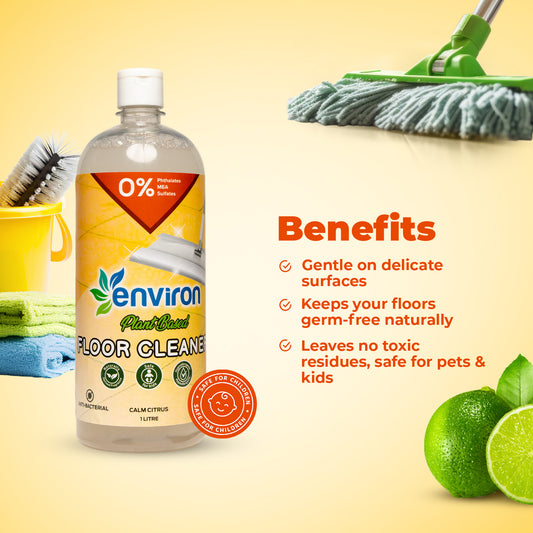
Environ Floor Cleaner combines plant-based surfactants, probiotics and enzymes as part of its cleaning system to help tackle everyday dirt, grease and residue. It is designed for compatible ceramic, marble, granite, natural wood, treated wood and metal surfaces.
The formulation is free from phthalates, parabens, bleach, ammonia, chlorine, formaldehyde, VOCs, dyes, and synthetic fragrance. Its 8X concentrated formula delivers more washes from every bottle, making it an effective choice for regular floor cleaning.


Thoughtful cleaning for the floors your pets live on every day.
A Clean Home and a Cared-for Pet Can Go Hand in Hand
Having a pet does not mean you need to stop cleaning your home. It means being more mindful of what you use, how you use it and what your pet may come into contact with afterwards.
Choose a floor cleaner that suits your surfaces and follow its recommended dilution and usage instructions. Keep pets away while the floor is wet, allow it to dry completely and store concentrated products securely.
A clean home and a cared-for pet can go hand in hand. It starts with knowing what you use, how you use it and what your pet may come into contact with afterwards.
References :
Pet poisons: Be mindful of these household products and cleaning agents (no date) ASPCA. Available at: https://www.aspca.org/news/pet-poisons-be-mindful-these-household-products-and-cleaning-agents (Accessed: 28 August 2026).
Chemicals inhaled from spray cleaning and disinfection products and their respiratory effects. A comprehensive review - sciencedirect. Available at: https://www.sciencedirect.com/science/article/pii/S1438463920305381 (Accessed: 28 August 2026).
Frequently Asked Questions
Why is my cat vomiting every time after I mop the floor?
Vomiting can have many causes. However, if you notice a consistent pattern after mopping, it is worth considering whether there could be a connection, particularly if your cat walks on the floor while it is still wet or licks its paws afterward. Keep your cat away from freshly mopped areas until the floor is completely dry and follow the manufacturer’s instructions. If vomiting continues or your cat seems unwell, contact a veterinarian.
Can floor cleaner make my cat sick?
Some floor cleaning products may cause problems if a cat is exposed to the product and later ingests residue while grooming. The level of risk depends on the specific formulation, concentration, and amount of exposure. Always follow the product label and keep cats away from wet cleaning solutions.
How long should I keep my cat away after mopping?
Keep your cat away until the floor is completely dry and any additional instructions on the product label have been followed. Drying time varies depending on the product, amount used, ventilation, and type of flooring, so there is no single safe number of minutes that applies to every cleaner.
Is floor cleaner toxic to cats?
It depends on the ingredients in the particular product and the level of exposure. Some cleaning ingredients can be harmful if swallowed or improperly exposed to, while the risk may be different when a product is correctly diluted and used as directed. Check the product label and follow the manufacturer’s instructions.
What should I do if my cat licks the floor after mopping?
Prevent further access to the area and check the product label for safety information. If your cat has swallowed cleaning solution, had significant exposure, or develops concerning symptoms, contact a veterinarian or an appropriate animal poison-control service for advice. Do not induce vomiting unless specifically instructed to do so by a veterinary professional or poison-control service.
Are plant-based floor cleaners safer for cats?
Not necessarily. “Plant-based” does not automatically mean a product is safe for cats. Safety depends on the complete formulation, concentration, and how the product is used.