
Quick Answer
Marble and wooden floors need different cleaning approaches because each surface reacts differently to cleaning products and everyday wear. Remove dust and grit regularly, use products suited to the specific surface and avoid harsh or abrasive cleaning methods. Marble is particularly sensitive to acidic products, while wooden floors need protection from unsuitable cleaners, residue and excess moisture.
A floor can be cleaned every day and still slowly lose the appearance you are trying to keep.
You use a little more floor cleaner, scrub a little harder and expect a better result.
The same thing can happen when there is a sudden spill. When oil, sauce or another stubborn mess lands on the floor, it is easy to scrub harder or use more cleaner to remove it quickly.
That can be the mistake.
You may notice it as a marble floor that no longer has the same shine, a cloudy patch that doesn't seem to disappear, or a wooden floor that feels different after mopping. It is easy to assume that the floor simply needs more cleaning. But sometimes, the problem is not how dirty the floor is. It is how the floor is being cleaned.
This matters even more in Qatar, where dust and fine sand can quickly find their way indoors. Regular cleaning is necessary, but repeated exposure to grit, unsuitable products or excess moisture can gradually affect marble and wooden floors.
Using a product that is not suitable for the surface can cause gradual damage, making your cleaning routine part of the reason your floor no longer looks as good as it once did.
Why Do Marble and Wooden Floors Need Special Care?
Marble and wooden floors are different from everyday flooring. Their natural composition, texture and finish make them more sensitive to everyday wear and environmental factors.
That is why they need special care to preserve their appearance, finish and condition over time.
Why does marble need careful cleaning?

Marble is a natural stone and comes in many varieties and some have a high proportion of calcium carbonate. Research published in the journal Construction and Building Materials suggests that exposure to acidic substances can make marble flooring more susceptible to staining and etching. Acid-based cleaners can react with the stone and cause etching, which appears as dull, cloudy or lighter patches on the polished surface.
Marble can also be scratched by dirt and fine grit that are repeatedly walked across it. This is especially worth considering in Qatar, where dust and sand can easily enter the home.
So, if your marble floor has lost its shine, using a stronger cleaner may actually make things worse. The goal is to remove everyday dirt without attacking or abrading the stone.
Why do wooden floors need careful cleaning?

Wooden floors need care for a different reason. Their protective finish can be affected by repeated exposure to unsuitable cleaning products, abrasive dirt and excessive moisture.
Harsh or unsuitable cleaning agents can leave residue, affect the finish or gradually change the appearance of the floor. At the same time, a study in the journal Buildings in MDPI suggests that too much water can enter vulnerable areas and contribute to swelling or other moisture-related stains.
This means cleaning a wooden floor is not simply about using less water. The cleaner itself matters too. A product that is too harsh, leaves a heavy residue or is not designed for the type of wood or finish can work against the very appearance you are trying to keep.
How to Clean Marble and Wooden Floors Step by Step
The safest routine is simple: remove dry dirt first, use a suitable cleaner, follow its dilution instructions and avoid leaving excess product or moisture behind.
Step 1: Remove dust, sand and grit.
Sweep, dust mop or vacuum the floor before applying a floor cleaner liquid. This is particularly important in Qatar, where fine dust and sand can become abrasive under foot traffic.
For marble, removing grit helps reduce scratches. For wooden floors, it prevents abrasive particles from repeatedly rubbing against the protective finish.
For accidental spills such as oil, sauce or other sticky food messes, resist the urge to scrub aggressively. Blot or lift the spill first, then clean the area with a suitable floor cleaner rather than repeatedly rubbing the surface.
Step 2: Choose a cleaner made for the surface.
Check whether the product is specifically suitable for marble, natural wood or treated wood.
For marble, choose a cleaner specifically formulated and tested for natural stone, preferably with a neutral or appropriately balanced pH. For wood, check that the cleaner is compatible with the wooden flooring and its finish.
A “floor cleaner” label by itself does not tell you whether a product is proper for every floor.
Step 3: Dilute it according to the instructions.
There is no universal amount of floor cleaner that works for every product. Concentrated formulations should be diluted according to the manufacturer's recommended dosage.
Using more products does not necessarily mean better cleaning. Too much can leave residue, which may make a polished surface look dull or a wooden floor feel sticky.
Step 4: Mop according to the surface
For marble, use a clean, soft mop and apply enough solution to clean the surface without flooding it.
For wooden floors, use a well-wrung, damp mop rather than a soaking wet one. Clean in manageable sections and avoid allowing water or cleaning solution to sit on the floor.
Step 5: Check the floor after cleaning.
Do not stop at “the floor is wet; therefore, it is clean.”
Once the surface dries, check whether it has:
● streaks or cloudy patches
● sticky residue
● visible cleaner film
● excess moisture
● changes in colour or finish
If these appear regularly, reconsider the cleaner, dosage or cleaning method rather than simply using more product.
Common Marble Floor Cleaning Mistakes to Avoid
Using vinegar: Acidic substances can etch marble and affect its polished appearance.
Using abrasive powders: Scouring powders and rough cleaning tools can scratch some marble surfaces.
Using too much cleaner: Excess product can leave a film that makes polished marble look cloudy or dull.
Cleaning over grit: Sand and dirt can act like abrasives when dragged across the floor.
Using an unsuitable multipurpose product: A cleaner being suitable for one hard surface does not automatically make it proper for natural stone.
Assuming dullness always means dirt: If a cloudy patch stays after cleaning, it may be etching or surface wear rather than something that needs more cleaning.

What Should You Look for in a Cleaner for Marble and Wooden Floors?
When a floor is cleaned regularly, the formulation deserves as much attention as the cleaning method.
Start with surface compatibility. A product should clearly state whether it is designed for marble, natural wood, treated wood or other surfaces you intend to clean.
For routine cleaning, a pH-neutral or pH-balanced formulation can be a sensible choice, particularly for surfaces that may be affected by acidic products. You should also look for clear dilution instructions, so you know how much product to use.
The ingredients matter too. According to a study published in The Pharma Journal, chemical-based cleaners may affect both the flooring and the health of the person using them. Plant-derived surfactants can provide effective cleaning action, while enzymes and probiotics included in formulations can tackle everyday dirt and residue, offering a gentler approach to cleaning with your health in mind.
However, “plant-based” should not be treated as a guarantee that a product is suitable for every floor. The formulation matters too. Ingredients, concentration, pH and residue can all influence how a cleaner performs on a particular surface. Plant-derived ingredients can be part of an effective cleaning formulation, but plant-based does not automatically mean suitable for every floor.
How Does Environ Fit into Marble and Wooden Floor Care?
For a floor that is cleaned regularly, choosing the right formulation can make a meaningful difference to the cleaning routine.
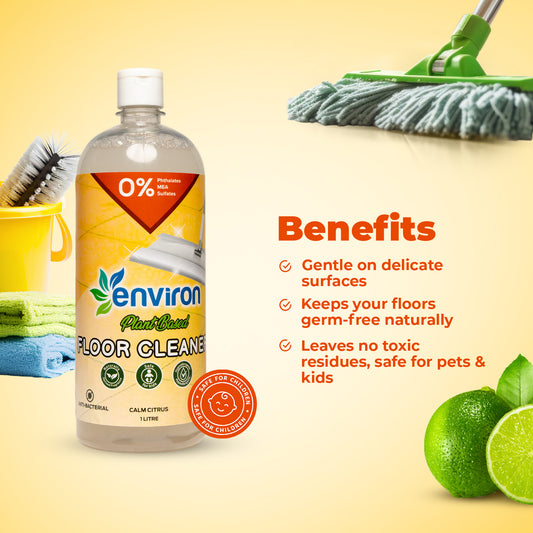
Environ Plant-Based Floor Cleaner combines plant-based surfactants, probiotics and enzymes as part of its cleaning system. It is formulated for compatible ceramic, marble, granite, natural wood, treated wood and metal surfaces.
The formulation is also free from phthalates and parabens, bleach, ammonia and chlorine, formaldehyde and VOCs, dyes and synthetic fragrance. Its 8X concentrated formula is designed for regular floor cleaning.

The important consideration is not simply that the cleaner is plant-based. It is that the formulation has been designed for the surfaces it is intended to clean and provides clear instructions for use.
That matters when the same floor is being cleaned again and again. The aim is to remove everyday dirt and residue without making aggressive cleaning part of your floor-care routine.
How Can You Keep Marble and Wooden Floors Looking Their Best?
Marble and wooden floors do not need complicated cleaning routines. They need consistent, surface-appropriate care.
Remove dust and grit before mopping. Choose a cleaner formulated for the surface. Follow the recommended dilution rather than using extra product. Keep marble away from acidic and abrasive cleaners and protect wooden floors from unsuitable cleaning agents as well as excess moisture.
Most importantly, do not assume that a floor needs a stronger cleaner simply because it looks dull. Sometimes the better solution is to change what you are using and how you are using it.
A clean floor should not come at the expense of the surface you are trying to protect.\
References:
- Pozo-Antonio, J. S., & Dionísio, A. (2021). Effects of accidental staining in carbonate stones: Physical, chemical and mineralogical changes. Construction and Building Materials, 297, 123774. https://doi.org/10.1016/j.conbuildmat.2021.123774
-
Dubey, R., Tiwari, D., Kaur, S., & Sharma, P. (2020). A study on popular floor cleansers and their potential health risks.https://doi.org/10.13140/rg.2.2.16298.03520
-
Coelho, P., Silva, A., & de Brito, J. (2021). How Long Can a Wood Flooring System Last? Buildings, 11(1), 23. https://doi.org/10.3390/buildings11010023