
Quick Answer
The right cleaner for your kitchen or bathroom depends on what you are cleaning, how often you clean it and what the formulation is designed to do. Marble and natural stone need different care from ceramic, porcelain and stainless steel. Choosing a surface-compatible, non-abrasive cleaner helps remove everyday dirt without unnecessarily affecting the finish over repeated cleaning.
You Choose the Surface Carefully. Did You Choose the Cleaner?
Think about your kitchen countertop.
When designing a home, many families in Qatar spend thousands of riyals choosing elegant marble countertops, premium granite worktops, stylish ceramic tiles and modern bathroom fittings. Every detail is carefully selected because these spaces are meant to stay beautiful for years.
Yet when it comes to choosing a cleaner for kitchen and bathroom surfaces, that same level of thought often disappears.
Most people buy a cleaner based on its fragrance, the promise of powerful cleaning or simply because it is familiar. Very few stop to ask whether it is actually suitable for the delicate surfaces they clean every day.
Months or years later, when a countertop begins to lose its shine or a bathroom surface no longer looks as polished as it once did, homeowners often blame age or everyday wear. Rarely do they consider that the cleaner they use every day could also be part of the story.
A cleaner does not know that your countertop is expensive. It only reacts according to its formulation and what it is designed to clean.
The issue usually isn't one bad cleaning session. It is repeated exposure.
You wipe the counter after breakfast.
You clean the sink at night.
You mop the floor again tomorrow.
When a product is not suited to the material, small effects can become visible over time.
That is why choosing a cleaner should start with the surface, not the fragrance on the bottle.
Why the Same Cleaner Doesn't Work for Every Surface
Your kitchen and bathroom may contain several different materials within a few feet of each other.
Marble countertop.
Ceramic tiles.
Porcelain flooring.
Stainless-steel sink.
Glass shower panels.
They may all look hard and durable.
They don't all behave the same way.
Natural stone such as marble is particularly sensitive to acidic cleaners. Marble contains calcium carbonate, which can react with acids and cause etching or dulling.
But the surface itself isn't the only thing worth thinking about. What is inside the cleaner matters too.
Many conventional cleaners rely on strong synthetic surfactants, artificial fragrances, dyes and other formulation additives to break down dirt, grease and stubborn buildup while leaving behind a strong “clean” smell.
That can make a product feel powerful.
But strong cleaning does not automatically mean better surface care.
When the same cleaner is used repeatedly on countertops, floors, sinks and other frequently cleaned surfaces, the formulation comes into contact with those materials again and again. Depending on the ingredients and the surface, repeated exposure can affect the finish, leave residue or simply make a delicate surface harder to maintain over time.
That is why choosing a cleaner should not come down to how strong it smells or how aggressively it cleans.
It should come down to what it is formulated to clean and what you are using it on.
A cleaner that works well for removing limescale from one surface may be completely inappropriate for another.
What Can Happen When You Use the Wrong Cleaner?
Surface damage doesn't always happen dramatically.
You may not notice anything after the first use.
Instead, look for the smaller signs:
-
Marble that looks duller than it used to
-
Cloudy patches on polished stone
-
Streaks that keep returning after cleaning
-
Floors that feel sticky after mopping
-
Grout that appears dull despite regular cleaning
-
Stainless steel showing unnecessary marks or scratches
-
Soap scum or mineral deposits returning quickly
Sometimes the surface isn't becoming harder to clean.
The cleaning routine is making the surface harder to maintain.
Using too much product can also create another problem. Instead of removing dirt completely, excess cleaner can leave a film behind that attracts dust and makes surfaces look dull or feel sticky.
That is particularly frustrating when it happens after using a floor cleaner liquid on a surface you clean several times a week.
You clean them because you want them to feel fresh. A day later, they feel dusty again.
The problem may not be the floor.
It may be what the cleaner left behind.
What Should You Actually Check Before Buying a Cleaner?
Once you know that different surfaces react differently to cleaning products, the label becomes more useful.
You don't need to understand every chemical name.
Start with the things that actually affect how you use the product.
Check the surfaces it is designed for. If you are cleaning marble, granite, ceramic, porcelain or wood, make sure the product specifically lists that material as compatible.
Check how it is meant to be used. A product intended for occasional deep cleaning may not be the same choice you want for surfaces cleaned every day.
Check the recommended dosage. More product does not mean more cleaning. On floors especially, excess product can make rinsing difficult and contribute to a film being left behind.
And look beyond fragrance. A strong scent tells you that the product smells strong. It does not tell you whether it is suitable for the surface underneath it.
The label should answer one simple question:
“Is this product actually designed for what I am about to clean?”
Why This Matters in Qatar Homes
In Qatar, cleaning is rarely a once-a-week job.
Dust enters homes regularly. Floors are mopped frequently. Kitchens deal with daily grease and food residue, while bathrooms constantly face moisture, soap scum and mineral buildup.
That means the same cleaning products come into contact with your surfaces again and again.
This is particularly important when your home has marble flooring, granite countertops, polished porcelain or other premium finishes. The more often you clean a surface, the more important your everyday cleaning product becomes.
You are not choosing a cleaner for one day.
You are choosing what touches that surface every week, every month and eventually every year.
A More Considered Approach to Everyday Cleaning
This is where plant-based cleaning products take a different approach.
Instead of relying primarily on harsh chemical cleaning systems, strong synthetic ingredients, and heavy fragrances to create the impression of effective cleaning, plant-based formulations utilise ingredients such as plant-derived surfactants, enzymes, and other bio-based cleaning agents that break down everyday dirt, grease and residue while being gentle on delicate surfaces.
Environ follows this approach across its range.


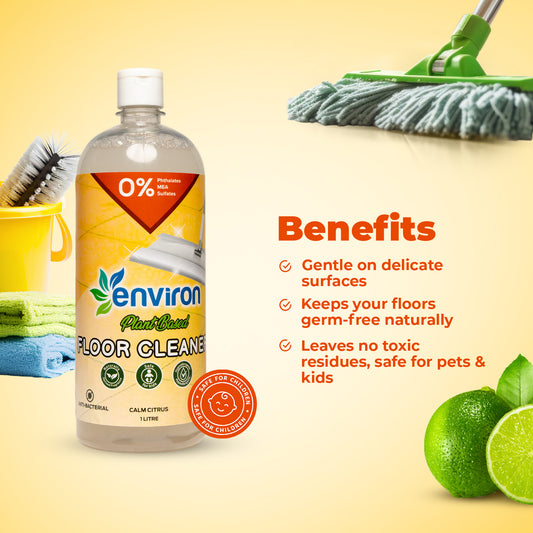
For compatible floors, Environ Plant-Based Floor Cleaner provides an everyday cleaning option for surfaces including ceramic, marble, granite, natural wood and metal. Its formulation combines probiotics, bio-enzymes and essential oils to tackle everyday dirt and stains while being gentle on delicate surfaces. It also offers up to 8× more washes than leading brands, making it practical for frequent floor cleaning.


For bathrooms, Environ Plant-Based Toilet and Sink Cleaner is designed to tackle everyday stains, odours, limescale and soap scum across compatible surfaces such as ceramic, marble, granite, plastic and tile. Its plant-based formulation is biodegradable and antibacterial, giving you a practical option for regular bathroom cleaning without relying on harsh chemicals.


For multiple compatible surfaces around the home, Environ Plant-Based All Purpose Cleaner offers a flexible everyday option for areas such as kitchen counters, bathroom tiles sand living-room furniture. Its biodegradable, non-toxic formulation is suitable for surfaces including ceramic, marble, granite, natural wood, treated wood and metal.
The idea isn't to keep adding bottles under the sink.
It is to choose a cleaner that makes sense for what you are actually cleaning.
Explore Environ's plant-based cleaning range for everyday home care
The Bottom Line
You probably spent time choosing the right marble, granite, tiles and fittings for your home.
So it makes sense to give some thought to what you use to clean them every day.
A cleaner can remove the dirt but the formulation still matters because it comes into contact with the same surfaces again and again. Choosing a gentle and compatible product, using the right amount and avoiding unnecessary harshness can make everyday cleaning part of surface care, rather than something that works against it.
Because your surfaces don't just need to look clean today.
They need to stay beautiful long after the cleaning is done.
Frequently Asked Questions
What is the best cleaner for marble surfaces?
A cleaner formulated for marble and other compatible natural stone surfaces is the better choice for everyday care. A plant-based, non-abrasive formulation can be a considered option when it is specifically designed for marble and used according to its instructions.
Can I use a toilet cleaner on marble bathroom floors?
Not necessarily. A toilet cleaner may be designed for the toilet itself rather than the surrounding marble floor. Always check the surfaces listed by the manufacturer before use and choose a formulation that is suitable for both the cleaning task and the material.
Why does my floor become sticky after mopping?
This can happen when too much floor cleaner is used or when cleaning-product residue is left behind after mopping. Following the recommended dilution helps prevent excess product from building up on the floor.
Is plant-based cleaner as effective as conventional cleaner?
Yes. A properly formulated plant-based cleaner can effectively remove everyday dirt, grease, stains and household residue. The difference is in the cleaning formulation and the ingredients used to achieve that performance, not whether the product is capable of cleaning effectively.
Why should I avoid choosing a cleaner based only on fragrance?
A strong fragrance tells you how the product smells, not how well it cleans or whether it is suitable for a particular surface. Surface compatibility and formulation are more useful factors when choosing a cleaner for regular household use.
Which Environ cleaners are suitable for floors, bathrooms and multiple surfaces?
Environ offers different plant-based cleaners for different household cleaning needs. Plant-Based Floor Cleaner is designed for compatible flooring, Plant-Based Toilet & Sink Cleaner for compatible bathroom surfaces and Plant-Based All-Purpose Cleaner for multiple compatible household surfaces. Always check the product instructions before use.