
Quick Answer
If your clothes make you itch after washing, the fabric itself is not always the cause. Sometimes the reason is linked to your laundry routine, such as detergent residue, lingering fragrance, fabric conditioners or incomplete rinsing. In other cases, your skin may simply be more sensitive than usual. The important thing is that itching after wearing freshly washed clothes is not automatically a sign that something is seriously wrong. By understanding what changed and making a few practical adjustments, you can often narrow down the most likely cause.
Why Do Clothes Start Itching Only After Washing?
If your clothes felt comfortable before washing but suddenly feel itchy afterwards, the wash cycle is the first place worth investigating.
Why? Because washing introduces new variables.
You may have used more laundry detergent than the machine could rinse away effectively. You may have switched to a new washing liquid for clothes or liquid detergent. A different fabric conditioner or fabric softner may contain a fragrance or formulation your skin responds to differently. Even washing larger loads can make thorough rinsing more difficult.
This does not automatically mean one laundry product is causing the problem. Many people use the same products without experiencing discomfort.
Instead, ask one simple question:
What changed?
If the itching began after a change in your detergent , product dosage, wash cycle, or load size, you have a logical place to start investigating before blaming the fabric itself.
Why Does It Affect You but Not Everyone Else?
If everyone in your home wears clothes washed in the same machine but only you experience itching, individual skin sensitivity may also be part of the picture.
Skin does not respond the same way from person to person. Dry skin, eczema, seasonal allergies, or changes in the skin barrier can make one person more sensitive to everyday fabric contact than another.
Your skin can also become more sensitive over time. A laundry routine that felt comfortable a few months ago may suddenly feel different if your skin has become drier or more reactive.
This is why it is often more useful to look at the interaction between your skin, clothes, and laundry routine rather than deciding that one product is simply “good” or “bad.”
If nothing has changed in the way you wash your clothes, consider whether something may have changed with your skin instead.
Did Something Change in Your Laundry Routine?
Think back to when the itching started.
Did you change your laundry detergent ? Increase the dosage ? Introduce a new laundry conditioner? Start washing larger loads or using a shorter cycle?
The timing matters.
If one of these changes happened around the same time the itching began, start there. Return to your previous routine or change one factor at a time and observe what happens over the next few washes.
If nothing has changed, your skin or another environmental factor may deserve closer attention.
What Does Research Say About Laundry Products and Skin?
Research suggests that laundry detergent exposure may affect the skin barrier under certain conditions.
A 2024 study published in Allergy investigated the effects of household laundry detergents on mouse skin and ex vivo human skin. Researchers found that detergent exposure disrupted skin-barrier integrity and increased markers linked to inflammation in their experimental models.
The human skin model also showed a significant reduction in barrier integrity following detergent exposure.
However, this does not mean that laundry detergent causes itching or skin irritation in everyone. The study examined direct detergent exposure under controlled experimental conditions and did not test people wearing normally washed clothes in everyday life.
Clinical guidance offers a practical perspective. The American Academy of Dermatology recommends fragrance-free and dye-free laundry detergent for people with eczema.
The takeaway is simple: if itching repeatedly appears after wearing freshly washed clothes, your laundry products and washing routine may be factors worth reviewing, particularly if your skin is already sensitive.
What Should You Try First?
If your clothes only seem to make you itch after washing, don't replace every laundry product at once. Make one change at a time so you can identify what actually makes a difference.
Step 1: Review Your Detergent Dosage
More laundry or liquid detergent does not necessarily mean cleaner clothes. Using more than the recommended amount may make thorough rinsing more difficult.
Follow the manufacturer's dosage instructions based on your load size and how soiled the clothes are.
Step 2: Give Clothes an Extra Rinse
If you suspect detergent or fabric conditioner residue, an additional rinse cycle may help remove more product from the fabric.
Consider this especially for T-shirts, towels, underwear, and bed sheets that remain in close contact with your skin.
Step 3: Change One Laundry Product at a Time
If you recently introduced a new washing liquid, fabric softener, or laundry conditioner, don't change everything at once.
Change one product and observe the next few wash cycles. This makes it easier to identify what may be contributing to the discomfort.
Step 4: Wash New Clothes Before Wearing Them
New clothing may carry manufacturing finishes, dyes, or processing residues. Washing garments before their first wear may improve comfort, particularly for sensitive skin.
These steps may not resolve every case of itching, but they give you a practical way to investigate the possible cause before making unnecessary changes.
When Should You See a Dermatologist?
Occasional itching after wearing freshly washed clothes is not usually a medical emergency. However, persistent or worsening symptoms deserve professional attention.
Consider speaking with a dermatologist if:
-
The itching continues even after changing your laundry routine.
-
You develop a rash, swelling, blisters, or cracked skin.
-
The discomfort regularly interferes with sleep or everyday activities.
-
You have a history of eczema, contact dermatitis, or other chronic skin conditions and your symptoms become worse.
A dermatologist can assess whether the irritation is related to your skin, environmental factors, or another underlying condition. Self-diagnosing persistent skin problems may delay appropriate treatment.
What Should You Look for in Laundry Products for Sensitive Skin?
No laundry product or washing detergent will feel the same for everyone. If you have sensitive skin, look beyond fragrance and consider the overall formulation.
When comparing laundry products, check whether they:
-
Clean effectively without relying on overpowering fragrance.
-
Clearly communicate their ingredients.
-
Use thoughtfully selected cleaning ingredients.
-
Are designed for regular clothing and bedding care.
Remember, a strong scent is not proof of better cleaning. What matters is how effectively the formulation removes dirt, oils and everyday stains.
How Environ Approaches Everyday Laundry Care
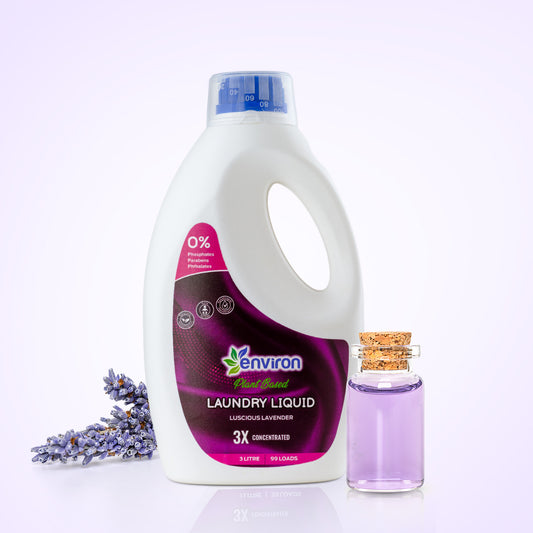
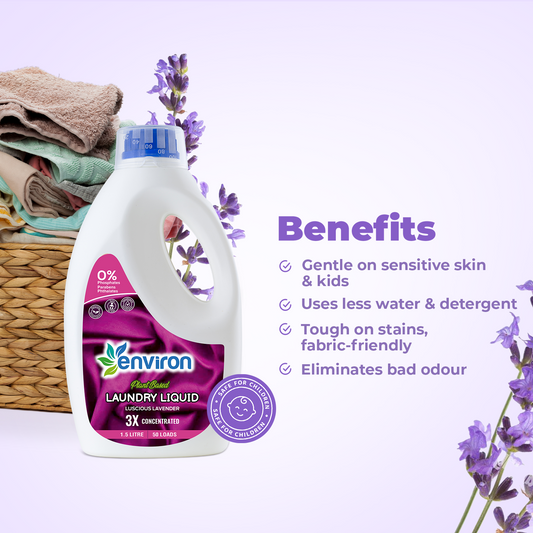
Environ's plant-based laundry care range follows an ingredient-first approach to everyday cleaning.
Its formulations combine plant-derived surfactants and bio-enzymes to help remove everyday dirt, stains and odours while supporting regular fabric care.
No Toxins, No Worries
Environ's laundry care formulations are free from:
-
Phthalates and parabens
-
Bleach, acids, and chlorine
-
Formaldehyde and VOCs
-
Heavy metals
-
Optical brighteners
-
Dyes
-
Toxic synthetic fragrances
This gives families greater clarity when reviewing the products used for everyday clothing and bedding care.
Environ's commitment to responsible home care is also supported by recognised manufacturing and quality standards, including GreenPro Certification, IFRA-compliant fragrance practices and WHO-GMP manufacturing principles.
Conclusion
If your clothes make you itch after washing, start by reviewing what changed. Check your detergent dosage, rinse cycle, laundry products, and whether your skin has become more sensitive.
Make one adjustment at a time so you can identify what actually helps. If the itching persists or is accompanied by a worsening rash, swelling, blisters, or cracked skin, speak with a dermatologist.
For families reviewing their everyday laundry routine, thoughtfully formulated products can also be part of a more considered approach to clothing and fabric care.
Why do my clothes only make me itch after washing?
If itching only starts after clothes have been washed, the washing process may have introduced a new factor, such as detergent residue, lingering fragrance, fabric conditioners, or changes in your laundry routine. Individual skin sensitivity also plays an important role.
Can detergent residue stay on clothes after washing?
Small amounts of detergent may remain on fabrics if too much product is used, clothes are overloaded in the washing machine, or rinsing is incomplete. While this does not affect everyone, it may contribute to discomfort for people with sensitive skin.
Can fabric conditioner cause itchy skin?
Some people may find that certain fabric conditioners or laundry conditioners contribute to skin discomfort, particularly if they are sensitive to specific ingredients or fragrances. Reviewing one product at a time can help identify whether it is a contributing factor.
Why does only one person in my family experience itchy clothes?
Skin sensitivity varies from person to person. Factors such as eczema, dry skin, or differences in the skin barrier mean that one family member may react differently even when everyone wears clothes washed in the same machine.
Should I wash my clothes again if they make my skin itch?
If you suspect detergent residue, rewashing the clothes using the correct detergent dosage and an extra rinse cycle may help. If symptoms continue, consider reviewing your laundry products or consulting a dermatologist.
What should I look for in laundry products if I have sensitive skin?
Many people with sensitive skin prefer laundry products that clean effectively, avoid unnecessary harsh ingredients, offer greater ingredient transparency, and rely on balanced formulations rather than strong fragrances alone.